Showing posts with label drip loop. Show all posts

Wednesday, May 17, 2017

Your wind turbine’s power and data cables may be wearing faster than you think

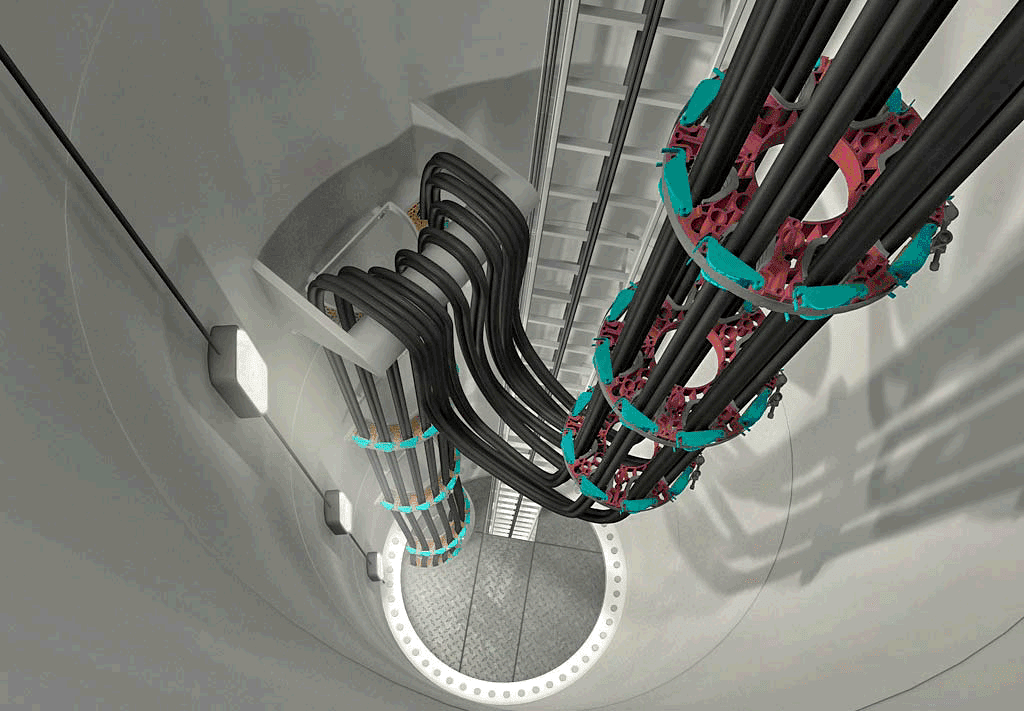
The drip loop is the bundle of cables responsible for carrying all the power, data, signals, and communication for everything generated inside a nacelle. The loop is needed to provide enough slack for the turbine to yaw a few revolutions keeping it pointed into the wind.


While the cables in this loop meet wind industry standards, especially for torsion, oil resistances, and temperature, current industry practice of tightly bundling them has serious impacts.

The biggest problem with closely arranging cables in this manner is there can be as many as 16 tightly bundled together, twisting and rubbing against each other. This arrangement creates excessive heat and wears down the jacket insulation, ultimately exposing a cable conductor which can carry between 600 to 1,000V.
This wear can appear only a few months after the start of operations but is often missed or overlooked during end-of-warranty inspections or when competing with other major corrective action.

It’s no surprise that the abrasion issue can eventually lead to turbine faults and downtime, and in worst cases, serious injury to technicians. “Over the past 15 years, I have visited many wind farms with trash containers filled with worn cables that had been cut out of the drip loop,” says Jim Moorman, Wind Industry Manager at Lapp USA, a global cable manufacturer.
Three wind-industry specialists have recognized the problem and joined forces to deliver a device that solves the premature cable wear issue along with expert installation. The companies, System One Services, Hydac, and Lapp USA, collaborated on the design of the SOHL, a turnkey cable-management system, able to address the issue of drip loop cable tear

Click here to access the full article


Monday, March 31, 2014

New Cable Requirements for Large Wind Turbines


Wiring changes are looming for wind turbines.

The electrical systems on large wind turbines will soon be subject to a new standard, UL 6141, which could result in drastic changes to cabling practices. The standard applies to both new and refurbished wind turbines that generate more than 500 kilowatts of power. 

While UL 6141 has not yet been finalized, it proposes strict limits on the use of appliance-wiring material (AWM) within and between key generator subsystems.

The limits spring from a requirement that all accessible wiring must be either enclosed in a raceway or rated for tray cable usage. Since only UL listed cable offer the tray rating, AWM will no longer make the grade in many turbine wiring applications.

Heres a breakdown of how the new standard will likely affect the different wind turbine subsystems:

Gearbox. There is no UL component standard specifically for gearboxes, so UL 6141 will apply to the wiring for gearbox components such as heaters and PT 100 temperature sensors.

Generators. The existing UL component standard for generators permits AWM cables under limited circumstances. To use AWM in generator wiring, there must be a ready-to-connect cable with connector. The generator must also be fitted with a grounding cable within the generator itself.  Since neither option is common with wind turbine generator manufacturers today, UL listed cable products will likely be the safest design strategy once UL 6141 comes to pass.

Tower. Since there is no UL component standard for the tower, UL 6141 applies. The proposed standard clearly calls for listed products for cables that run vertically up the towerincluding those for power, control signals, lighting and hoists.

Drip Loop. Raceways are not commonly used in drip loops.  Assume that listed cable products will have to be used in this application.


To learn more about all the changes UL 6141 will bring, download our technical update.

www.lappusa.com/pdf/lapp_windpowerenergy_2012.pdf