Showing posts with label force. Show all posts

Thursday, August 4, 2016

Why do we need variable speed drives (VSD)?

Reasons for using  variable speed drives


There are many and diverse reasons for using variable speed drives. Some applications, such as paper making machines, cannot run without them while others, such as centrifugal pumps, can benefit from energy savings.
In general, variable speed drives are used to:
  1. Latch the speed of a drive to the process requirements
  2. Latch the torque of a drive to the process requirements
  3. Save energy and improve efficiency

The needs for speed and torque control are usually fairly obvious.
Modern electrical VSDs can be used to accurately maintain the speed of a driven machine to within ±0.1%, independent of load, compared to the speed regulation possible with a conventional fixed speed squirrel cage induction motor, where the speed can vary by as much as 3% from no load to full load.


The benefits of energy savings are not always fully appreciated by many users. These savings are particularly apparent with centrifugal pumps and fans, where load torque increases as the square of the speed and power consumption as the cube of the speed.
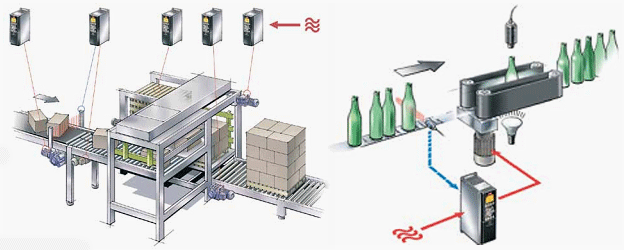
Substantial cost savings can be achieved in some applications.


An everyday example, which illustrates the benefits of variable speed control, is the motorcar. lt has become such an integral part of our lives that we seldom think about the technology that it represents or that it is simply a variable speed platform. lt is used here to illustrate how variable speed drives are used to improve the speed, torque and energy performance of a machine. It is intuitively obvious that the speed of a motorcar must continuously be controlled by the driver (the operator) to match the trafiic conditions on the road (the process).

In a city, it is necessary to obey speed limits, avoid collisions and to start, accelerate, decelerate and stop when required.

On the open road, the main objective is to get to a destination safely in the shortest time without exceeding the speed limit.

The two main controls that are used to control the speed are the accelerator, which controls the driving torque, and the brake, which adjusts the load torque.
A motorcar could not be safely operated in city traffic or on the open road without these two controls. The driver must continuously adjust the fuel input to the engine (the drive) to maintain a constant speed in spite of the changes in the load, such as an uphill, downhill or strong wind conditions. On other occasions he may have to use the brake to adjust the load and slow the vehicle down to standstill.

Another important issue for most drivers is the cost of fuel or the cost of energy consumption. The speed is controlled via the accelerator that controls the fuel input to the engine.
By adjusting the accelerator position, the energy consumption is kept to a minimum and is matched to the speed and load conditions. Imagine the high fuel consumption of a vehicle using a fixed accelerator setting and controlling the speed by means of the brake position.


Click here to access the full article


Monday, March 16, 2015

Basic Mechanical Terms used in Drives Applications

Basic Mechanical Terms used in Drives Applications

Terms below are the basic mechanical terms associated with the mechanics of DC drive operation. Many of these terms are familiar to us in some other context.

  1. Force
  2. Net Force
  3. Torque
  4. Speed
  5. Linear Speed
  6. Angular (rotational) Speed
  7. Acceleration
  8. Law of Inertia
  9. Friction
  10. Work
  11. Power
  12. Horsepower


Force

In simple terms, a force is a push or a pull. Force may be caused by electromagnetism, gravity, or a combination of physical means. The English unit of measurement for force is pounds (lb).


Net Force

Net force is the vector sum of all forces that act on an object, including friction and gravity. When forces are applied in the same direction they are added. For example, if two 10 lb forces were applied in the same direction the net force would be 20 lb.

Net force
If 10 lb of force were applied in one direction and 5 lb of force applied in the opposite direction, the net force would be 5 lb and the object would move in the direction of the greater force.


Net force
If 10 lb of force were applied equally in both directions, the net force would be zero and the object would not move.

Net force


Torque

Torque is a twisting or turning force that tends to cause an object to rotate. A force applied to the end of a lever, for example, causes a turning effect or torque at the pivot point.
Torque (tau) is the product of force and radius (lever distance).
Torque (tau) = Force x Radius
In the English system torque is measured in pound-feet (lb-ft) or pound-inches (lb-in). If 10 lbs of force were applied to a lever 1 foot long, for example, there would be 10 lb-ft of torque.

10 lb-ft of torque

An increase in force or radius would result in a corresponding increase in torque. Increasing the radius to 2 feet, for example, results in 20 lb-ft of torque.

20 lb-ft of torque


Click here to read the full article