Showing posts with label copper. Show all posts

Thursday, April 13, 2017

Industrial control wiring and cabling guide


Wires and preparation for control wiring

Electrical equipment uses a wide variety of wire and cable types and it is up to us to be able to correctly identify and use the wires which have been specified. The wrong wire types will cause operational problems and could render the unit unsafe.

Such factors include:
  • The insulation material;
  • The size of the conductor;
  • What it’s made of;
  • Whether it’s solid or stranded and flexible.
These are all considerations which the designer has to take into account to suit the final application of the equipment.
A conductor is a material which will allow an electric current to flow easily. In the case of a wire connection, it needs to be a very good conductor. Good conductors include most metals. The most common conductor used in wire is copper, although you may come across others such as aluminium. An insulator on the other hand is a material which does not allow an electric current to flow. Rubber and most plastics are insulators.


Insulation materials

Wires and cables (conductors) are insulated and protected by a variety of materials (insulators) each one having its own particular properties. The type of material used will be determined by the designer who will take into account the environment in which a control panel or installation is expected to operate as well as the application of individual wires within the panel.
As part of the insulating function, a material may have to withstand without failing:
  • Extremes of current or temperature;
  • A corrosive or similarly harsh environment;
  • Higher voltages than the rest of the circuit.
Because of these different properties and applications, it is essential that you check the wiring specification for the correct type to use.

Click here to access the full article

Monday, June 13, 2016

What Would Be The Best Conductor Material for Electrical Cables

Al or Cu conductor…

The conductivity of copper is 65% higher than that of aluminium which means that the conductor size of similarly rated cables is proportionately smaller. Correspondingly less expense is then incurred in providing for insulation, shielding and armouring the cables themselves. Transport of the less-bulky cables is easier and so is installation. In limited spaces in cable ducts, the smaller volume and better ductility of copper cables can have an even larger benefit.
Copper cables are easily jointed because copper does not form on its surface a tough, non-conducting oxide. The oxide film that does form is thin, strongly adherent and electrically conductive, causing few problems.
Cleaning and protection of copper is easy and if joints are made as recommended they will not deteriorate to any great extent with age, which saves on maintenance costs.
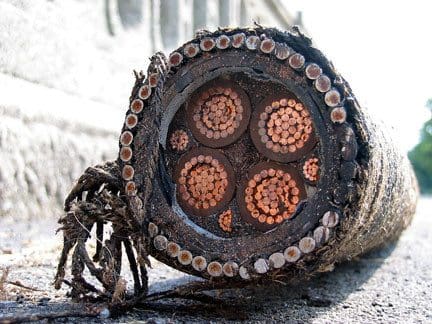
HV copper cable
HV copper cable (photo credit: businessinsider.com)

For the same nominal current rating, the cable with the aluminum conductor is significantly larger in diameter, carries a proportionally greater volume of insulation and is not so easily installed because of being less flexible. Aluminum is notoriously difficult to joint reliably. Table 1 compares aluminum and copper conductors for equivalent current rating.

Table 1 – Comparison between Copper and Aluminum Conductors in XLPE Insulated Steel- Wire Armoured Cables.
CharacteristicCopper 300 m2Aluminum 500 m
Overall diameter (mm)66.583.9
Minimum bending radius (mm)550700
Max DC resistance/km at 20o C (ohm)0.06010.0617
Approx. voltage drop/A/m (mV)0.1900.188
Continuous current rating, drawn in to duct (amp)496501
(Cable: to BS 5467 (& IEC 502) 4-core, stranded conductors, XLPE insulation, PVC bedding, steel wire armour, PVC oversheath, rated at 0.6/1.0 kV)

These notes have largely been derived from reference to BS 7450 which is identical to IEC 1059. Both of these give full details of the variables to be considered and the ways in which optimum cable size determinations can be made.


Click here to access the full article


Tuesday, April 12, 2016

What Would Be The Best Conductor Material for Electrical Cables


HV copper cable (photo credit: businessinsider.com)

Al or Cu conductor…


What Would Be The Best Conductor Material for Electrical CablesThe conductivity of copper is 65% higher than that of aluminium which means that the conductor size of similarly rated cables is proportionately smaller. Correspondingly less expense is then incurred in providing for insulation, shielding and armouring the cables themselves. Transport of the less-bulky cables is easier and so is installation. In limited spaces in cable ducts, the smaller volume and better ductility of copper cables can have an even larger benefit.
Copper cables are easily jointed because copper does not form on its surface a tough, non-conducting oxide. The oxide film that does form is thin, strongly adherent and electrically conductive, causing few problems.


Cleaning and protection of copper is easy and if joints are made as recommended they will not deteriorate to any great extent with age, which saves on maintenance costs.

HV copper cableFor the same nominal current rating, the cable with the aluminium conductor is significantly larger in diameter, carries a proportionally greater volume of insulation and is not so easily installed because of being less flexible. Aluminium is notoriously difficult to joint reliably. Table 1 compares aluminium and copper conductors for equivalent current rating.


Table 1 – Comparison between Copper and Aluminium Conductors in XLPE Insulated Steel- Wire Armoured Cables.
 
Characteristic Copper 300 m2 Aluminium 500 m
Overall diameter (mm) 66.5 83.9
Minimum bending radius (mm) 550 700
Max DC resistance/km at 20o C (ohm) 0.0601 0.0617
Approx. voltage drop/A/m (mV) 0.190 0.188
Continuous current rating, drawn in to duct (amp) 496 501

(Cable: to BS 5467 (& IEC 502) 4-core, stranded conductors, XLPE insulation, PVC bedding, steel wire armour, PVC oversheath, rated at 0.6/1.0 kV)


These notes have largely been derived from reference to BS 7450 which is identical to IEC 1059. Both of these give full details of the variables to be considered and the ways in which optimum cable size determinations can be made.

Click here to access the full article

Tuesday, June 2, 2015

Few Aspects of Copper versus Aluminium

Conductor connections and terminations

The constructions of aluminum wire and terminals have both been revised from past years. At one time the conductor was nearly pure aluminum, now they are all much stronger 8000 series alloys, with physical characteristics similar to copper.
The wire terminations also have much more severe UL test requirements, resulting in reliable long-term connections when installed in accordance with instructions. There is a common misconception that only compression (crimp) lugs should be used with aluminum cables, but this is not true.
In the past with the use of the softer aluminum conductors, only compression connectors were suitable. However with the aluminum conductors used today and modern design and plating of mechanical pressure connectors, compression connectors are no longer required.
The terminals on molded case circuit breakers are typically plated aluminum alloy with mechanical setscrews, listed for use with either aluminum or copper conductors.


These lugs rated ALCU alleviate the need for more expensive compression connectors and the more laborious installations for these connectors.
The substitution of aluminum wire for copper always involves size and can also impact quantity. The size increase is usually one or two wire sizes.
It is more common to have compact stranding of aluminum wire than copper, which can reduce the conduit upsizing required. Even though physically larger the aluminum wire is lighter and easier to handle than the equivalent copper conductor. In
most cases the same lug can accommodate either aluminum or copper and has adequate wire range.
Any lug marked ALCU is suitable for use with either conductor. Another factor with the use of aluminum wiring for the supply or load from a piece of the electrical equipment is the size of the conduits. The use of aluminum conductors will result in either larger conductor size or more quantity of conductors. Either way, more or larger conduits will be utilized.
A design trend is always toward equipment with smaller footprints. Cost of the space in the structures housing the equipment is constantly increasing.
However in many cases there might not be physical space in the equipment for the termination of the conduits using aluminum conductors while there is adequate space for the quantity and size of the conduits for the copper conductors.

Click here to read the full article